Russian Translation Services in India: Supporting Industrial Cooperation and International Trade
As Indian companies pursue opportunities in Russia and other Russian-speaking markets, accurate multilingual documentation is becoming an important part of international business planning. From pharmaceutical exports and engineering projects to machinery procurement, energy cooperation and technical exchange, Russian Translation Services help organisations communicate commercial requirements and specialised information across language barriers.
India and Russia maintain a longstanding economic partnership spanning energy, pharmaceuticals, fertilisers, engineering goods and other sectors. For businesses operating within this relationship, effective communication is essential when preparing contracts, exchanging technical specifications, coordinating suppliers and managing project documentation.
When Business Documents Cross Language Barriers
International transactions generate substantial documentation at every stage. Indian companies working with Russian-speaking customers, distributors and suppliers may require translations of business agreements, quotations, purchase orders, company profiles, invoices, tender documents and product catalogues.
These materials must communicate commercial terms clearly and preserve important details such as prices, quantities, delivery conditions and contractual responsibilities. Inconsistent terminology or an unclear translation can create unnecessary questions during negotiations and project execution.
Exporters may also require Russian versions of websites, product descriptions and marketing materials when presenting their offerings to customers in Russia or other Russian-speaking markets. The appropriate terminology and content should reflect the intended audience and the purpose of the communication.
Engineering and Technical Translation Requirements
Technical translation is particularly relevant to projects involving industrial machinery, manufacturing, energy, engineering and pharmaceuticals. Documents may include operating manuals, equipment specifications, installation instructions, maintenance procedures, safety information and technical reports.
Such content requires careful handling of specialised terminology, measurements, abbreviations and procedural instructions. Translators must understand the subject matter and preserve the intended technical meaning throughout the document.
A structured review process can include terminology verification, proofreading, numerical checks and consistency reviews. For complex assignments, reference materials and approved glossaries can help maintain uniform terminology across multiple documents.
Russian Translation for Legal and Official Documentation
Businesses and individuals may need Russian translation for contracts, corporate records, academic certificates, employment documents, personal records and immigration-related paperwork.
The required format depends on the receiving authority and the document’s intended use. Some applications may require certified translation, notarisation or other authentication procedures. Requirements differ between institutions and jurisdictions, so they should be confirmed before translation begins.
Confidentiality is equally important when documents contain commercial agreements, financial records, personal information or proprietary technical material. Clear project instructions and appropriate document-handling procedures help establish expectations for both parties.
Language Expertise and Localisation
Russian has its own grammatical structure, vocabulary and conventions for formal and professional communication. Accurate translation requires more than substituting words between languages; the final text must preserve context, tone and subject-specific meaning.
For companies entering Russian-speaking markets, localisation can also help adapt websites, product information and digital content to the intended audience. This may involve adjustments to terminology, presentation and communication style while maintaining consistency with the original message.
Artificial intelligence and machine translation can assist with certain tasks, but human review remains important for legal documents, technical instructions and other content where errors may have significant consequences.
Supporting Meetings and Technical Projects
International business communication often extends beyond written documentation. Indian companies working with Russian-speaking partners may require interpreters for supplier visits, factory inspections, business negotiations, technical training and corporate meetings.
Interpretation helps participants exchange information directly when they do not share a common language. Transcription, subtitling and voice-over services may also be required for training videos, corporate presentations, recorded discussions and product demonstrations.
Selecting the appropriate language service depends on the project’s subject matter, audience, communication format and quality requirements.
Preparing for Cross-Border Business Operations
For organisations working across India and Russian-speaking markets, identifying translation needs early can help improve project coordination. Defining the target audience, language direction, document type, technical requirements and delivery schedule provides a clearer basis for planning the work.
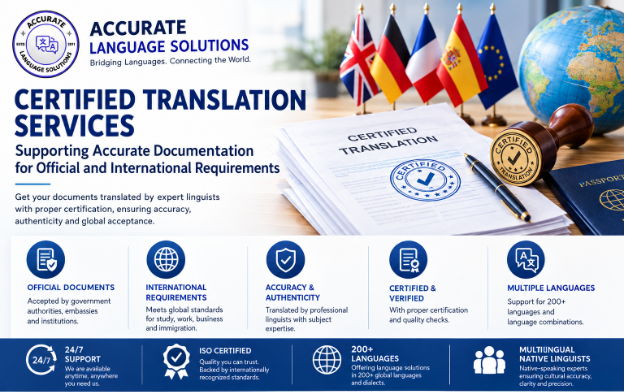
Accurate Language Solutions provides multilingual communication services, including translation, interpretation, transcription and voice-over. Further information is available at https://accuratelangsols.com/.
Professional Russian Translation Services can help businesses communicate commercial terms accurately, prepare technical documentation and coordinate information with Russian-speaking stakeholders. As international projects continue to require communication across languages, reliable translation remains an important part of effective business operations.

